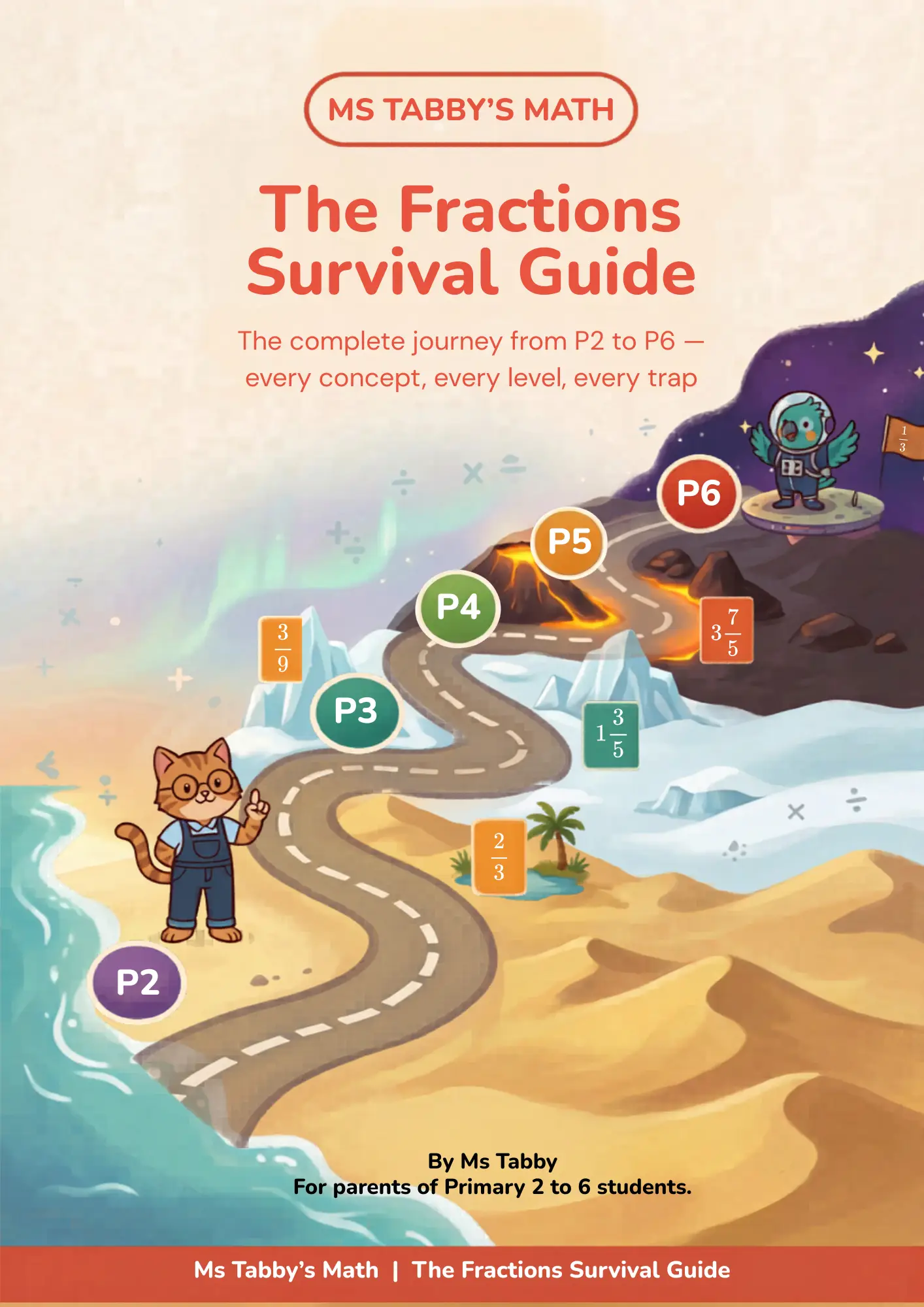
The Fractions Survival Guide maps the complete journey from Primary 2 to PSLE — every concept, every level, and every trap.
Join 3,000+ parents who have already downloaded. No spam.

"Ms Tabby, why is it that my child used to love Math, but now they see a Fraction question and just... freeze?"
— Polly (A Curious Parent)

"It's a great question, Polly. Fractions aren't just one topic—they're a chain. Each level, from P2 to PSLE, builds on the one before it."
"Often, the P5 struggle isn't about P5 fractions at all. It's usually a tiny gap from P3 that has finally become visible. Once we find that missing link, the 'freeze' disappears and the logic takes over."
— Ms Tabby (The Educator)
This guide maps the entire chain, so you can see exactly where your child is, and reclaim their math confidence level by level.
The complete fractions journey, mapped level by level:
Worked examples in full
Shared understanding for you and your child, one step at a time.
“Watch Out” alerts
Avoid the exact traps I see year after year before they happen.
A master checklist
Spot which question type you’re facing and which method to use instantly.
The LEAP approach
Logic, Equation, Application, Pattern — logic-first clarity for every child.
This guide is for you if your child feels like fractions are a big wall they just can't climb, if they're getting confused by endless 'short cuts' and rules, or if they've simply lost their math spark along the way.
It isn’t about memory work or drilling more sums. It’s about Logic First—the kind of understanding that makes the next topic feel like a natural next step, rather than a whole new set of rules to memorize.
Transforming math frustration into logic-led clarity for over 19 years.
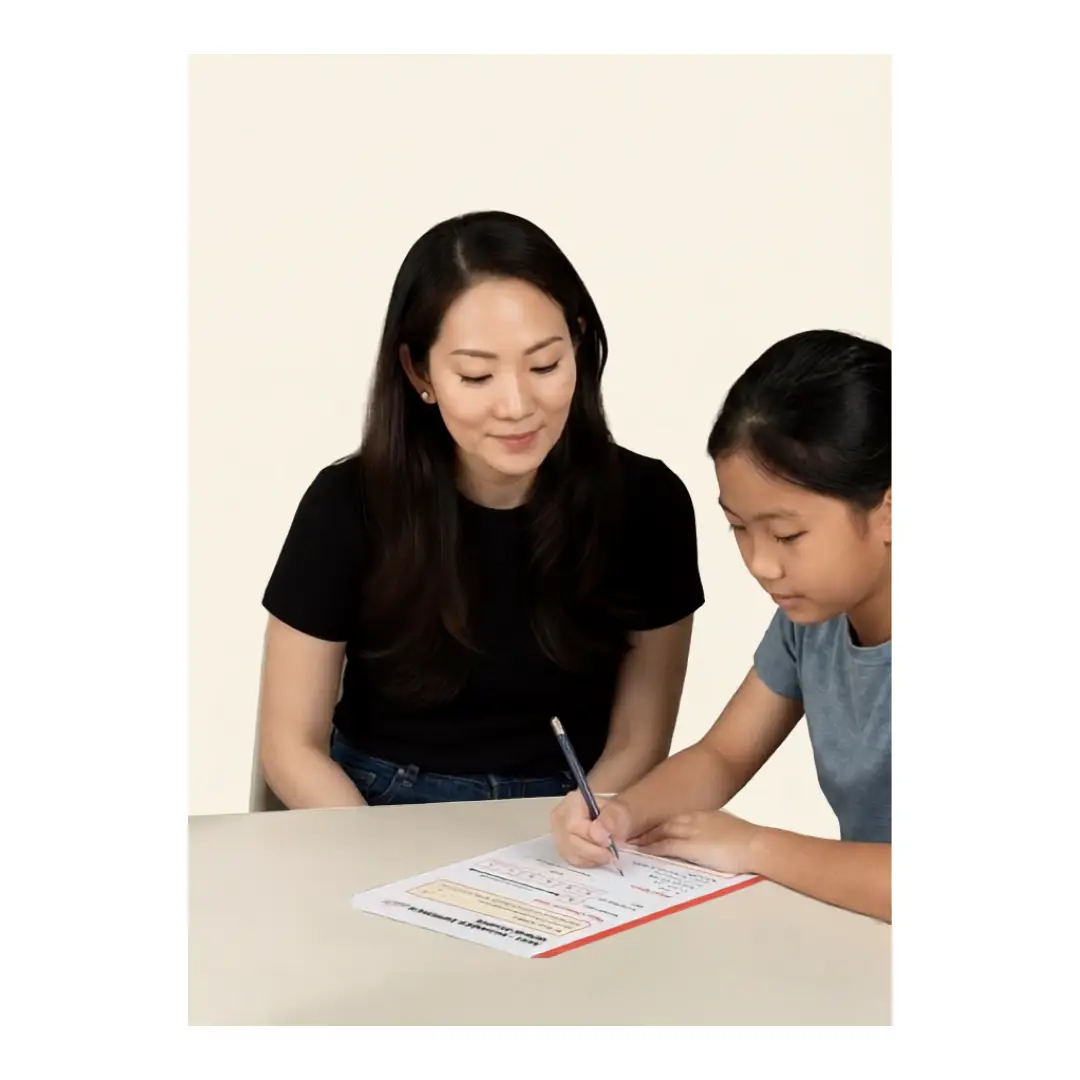
At Ms Tabby's Math, we watch children reclaim their confidence from the very first lesson. This transformation almost never comes from simply doing 'more' of what isn’t working.
It comes from scaling the hurdles that once felt like walls by leading with logic. That’s why I created this guide—to show you exactly how to spot and clear those hurdles together.
Ms Tabby's Math is founded by Ms Tabby, a former MOE Year Head & Head of Department with experience at MOE HQ. Having seen first-hand how the right foundation changes everything, her mission is to help every child love math by making it make sense.
— Ms Tabby
Real feedback from the children we teach every day.
Yi Xuan, Student
“You have always been very kind and understanding to us. With your help, I achieved 90/100! I hope to be in your class next year!”
“I finally feel like I understand Math, it’s not hard anymore. I’m starting to love math.”
— Jordann
“I enjoyed the lessons and felt that the 5 days bootcamp flew by too fast. I wished it could move slower.”
— Beatrice
“Your math lessons are wonderful! You are the best teacher I have ever had—ever!”
— Rav
“Thank you for helping me score well in my EYE. Your coaching really helped when I was having difficulties.”
— Sarah
“Thanks for teaching me Math and clarifying all my doubts. You’re simply the best!”
— Sho
“I love your lessons so much. They have let me learn a lot. Thank you for teaching me!”
— Zhi Yan
“Thank you for being such a kind and fun teacher. I really enjoy being in your class!”
— Siti
“Math is now my favourite subject and I like your lessons a lot. Thank you for teaching us!”
— Rachel
“I appreciate your teaching very much. I always look forward to your classes!”
— Yi Xuan
and many more....
Conveniently located near MRT stations across Singapore
Coming soon in 2027
Interactive online platform available for all levels. Learn from the comfort of your home with our specialized MOE math experts.
Join thousands of Singapore families building a firmer math foundation.
Pop your details in below and the Fractions Survival Guide will be on its way to your inbox.
You’ll also receive the occasional email from me with practical tips to help your child with maths. No spam, and you can unsubscribe any time.
Written by Ms Tabby — PSLE Math Specialist